
The Hum of the Deep
The desert floor of the Mojave did not sleep. Even at 3:00 a.m., when the heat of the day had bled away into the vast, indifferent obsidian of the California sky, the Goldstone Deep Space Communications Complex remained a hive of frenetic, low-frequency energy.
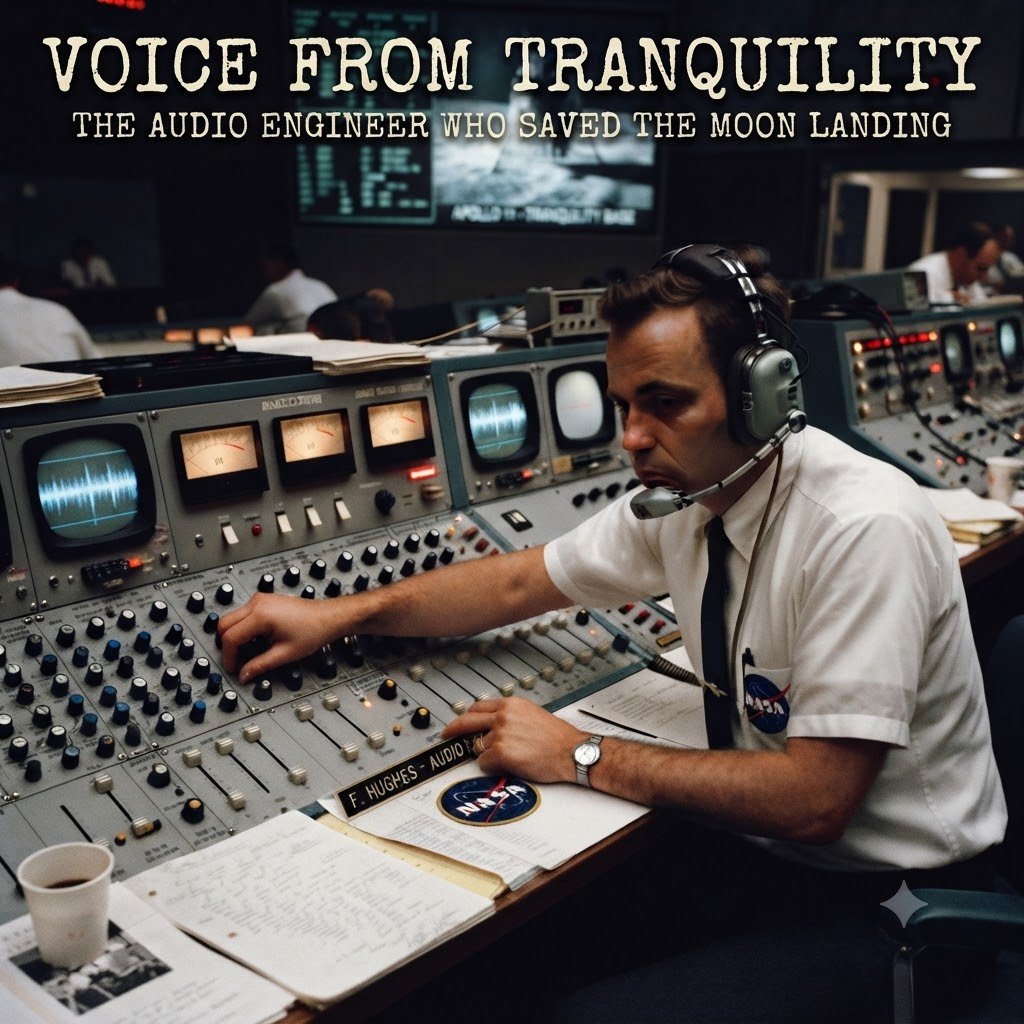
Elias Thorne stood in the center of the control room, his boots clicking rhythmically against the raised metal floor panels. The air here was recycled, cooled to a precise sixty-eight degrees, and scented with the ozone-sharp tang of overworked vacuum tubes and the stale, lingering aroma of burnt coffee. To the outside world, this place was a sterile monument to human ambition. To Elias, it was a cathedral of copper wire, soldering iron, and the terrifying fragility of physics.
He adjusted his glasses, the frames sliding down the bridge of his nose, and stared at the oscilloscope. A jagged green line danced across the cathode-ray tube, a visual heartbeat of the void.
“Baseline check, Thorne,” a voice barked from the back of the room. It was Miller, the shift supervisor, a man whose face seemed permanently etched with the stress of the Apollo 11 timeline. “The 210-foot dish is tracking the lunar trajectory, but the signal-to-noise ratio is fluttering. If we lose the carrier wave, we lose the mission. Is the filter bank holding?”
Elias didn’t turn around. He couldn’t afford the distraction. His hands, steady as a surgeon’s, hovered over the bank of toggle switches and rotary knobs. “The cryogenic maser amplifier is cooling within acceptable parameters, Miller,” Elias replied, his voice barely rising above the low, constant drone of the cooling fans. “But the atmospheric interference from the ionosphere is thicker tonight. It’s like trying to listen to a whisper through a hurricane.”
He reached out and tweaked a fine-tuning dial. The hum in the room—that deep, pervasive vibration that seemed to emanate from the very bedrock beneath the complex—shifted in pitch. This was the ‘Hum of the Deep,’ a sound that Elias felt in his marrow. It was the sound of the universe asserting its distance. Between Goldstone and the lunar module Eagle, there were 238,000 miles of vacuum, a cold, airless graveyard of radiation and cosmic debris. His job was to build a bridge across that distance, a bridge made of electrons and sheer human willpower.
Elias walked toward the main signal processing rack. He felt the weight of it then—not just the weight of the equipment, but the crushing, suffocating pressure of history. In a few days, Neil Armstrong and Buzz Aldrin would be sitting inside a tin can on the surface of the moon. If Elias failed, if his equipment suffered a catastrophic failure or if he miscalculated the gain by even a fraction of a decibel, the world would be met with nothing but the hiss of the void.
He thought of the millions of people waiting at home, huddled around television sets with rabbit-ear antennas, expecting to hear the words that would define the twentieth century. They didn’t know about the masers. They didn’t know about the signal-to-noise ratios or the way a solar flare could turn a transmission into a garbled mess of static. They lived in the illusion of clarity. Elias lived in the reality of the mess.
He pulled a patch cable from the rack, the plastic tip cool against his thumb. He inspected the contacts—clean, no oxidation. He plugged it back in with a satisfying click.
“Talk to me, Elias,” a colleague named Sarah whispered as she walked by, balancing two steaming cups of coffee. She caught his eye, her expression guarded. “You look like you’re trying to hold the antenna up with your bare hands.”
Elias offered a tight, tired smile. “Just making sure the vacuum doesn’t leak into the audio feed, Sarah.”
“It’s a big, lonely sky out there,” she said, leaning against the console. She looked up at the ceiling, as if she could see through the concrete and steel to the moon itself. “Sometimes I think about them, up there in the dark. It’s so quiet, isn’t it? No wind, no birds, no hum of traffic. Just the sound of their own breathing in those suits.”
“That’s exactly what I’m afraid of,” Elias murmured. “The silence is the enemy. It’s what we’re fighting against.”
He turned back to his station. The console was a chaotic landscape of glowing amber indicators and mechanical gauges. He picked up his headset, the leather earcups worn soft from years of use, and pulled them over his ears. Immediately, the ambient noise of the control room vanished, replaced by the oceanic roar of the cosmic background radiation. It was a chaotic, rushing sound—the literal leftover energy from the birth of the universe.
He leaned into the microphone. “Goldstone to Apollo 11, do you copy?”
There was no answer, of course. The Eagle was still in transit, but the ritual was essential. He had to calibrate the audio chain to the specific frequency of the lunar module’s transmitter. He watched the needle on the VU meter jump. It was too erratic. He adjusted the threshold, tightening the gate on the audio processor.
Clack. Clack. Thrum.
The rhythmic sound of the mechanical relays echoed in his headset. He was a technician, a man of wires and solder, but in this moment, he felt like a medium trying to summon a ghost. He was tasked with preserving the most important conversation in human history, yet he felt like a trespasser in a domain that didn’t want to be heard.
He leaned closer to the monitor. A faint, rhythmic pattern began to emerge from the static. It wasn’t the steady, predictable hum of the equipment. It was a subtle, pulsing irregularity—a modulation that shouldn’t have been there.
Elias froze. He checked the frequency settings. He verified the shielding on the cables. Everything was tight. Everything was perfect. And yet, beneath the expected hiss of the deep space network, there was something else. A faint, persistent cadence that felt almost intentional.
He tapped his pen against the console, his heart rate accelerating. Was it a hardware glitch? A rogue signal from a terrestrial source bouncing off the atmosphere? Or was it something else—something hiding in the noise, waiting for the moon to become the center of the world?
“Miller,” Elias said, his voice lower, more urgent. “Come look at this channel. I’m picking up an anomaly in the sub-carrier frequency.”
Miller stepped up behind him, peering over his shoulder. He squinted at the fluctuating green line. “It’s probably just a thermal spike in the receiver, Thorne. Don’t go looking for gremlins when the hardware is under this much stress. We have a mission to run.”
“It doesn’t look like a spike, Miller. It’s rhythmic.”
“Then filter it out,” Miller snapped, turning away to attend to a flickering status light on the telemetry wall. “We don’t need a clean signal for the technical logs; we need a clear signal for the world. If you can’t filter it out, ignore it. But do not—I repeat, do not—start chasing ghosts.”
Elias watched Miller walk away, the man’s footsteps fading into the general roar of the room. He turned back to the screen. The rhythmic pulse continued, a faint, metallic heartbeat that seemed to mock the precision of the entire Goldstone facility.
He reached for the fine-tuning knob again, his fingers hovering over the plastic. He had a choice. He could follow orders, bury the anomaly in the noise floor, and ensure that the audio remained within the expected parameters of NASA’s mission profile. Or, he could isolate it, listen to it, and risk everything—his career, his reputation, and the mission itself—to understand what was hiding in the vacuum.
He looked at the moon, visible through the high, narrow windows of the control room. It hung there, a pale, cratered eye watching them. It seemed closer tonight, heavier.
Elias took a deep breath, the air in his lungs feeling thin and artificial. He clicked a switch on his console, shunting the output to a separate, private recording deck. He wasn’t going to report it. Not yet.
He was the man at the console. He was the one who stood between the silence of the universe and the ears of a watching world. If there was a secret hidden in the static, he would be the one to hear it first.
He leaned into the headset, closing his eyes, and listened to the hum of the deep. It was no longer just the sound of space; it was a conversation, and for the first time in his life, Elias Thorne felt that he was finally beginning to understand the language of the void.
The pressure in the room seemed to intensify. The air conditioner hummed, the relays clicked, and the world outside continued its frantic preparations for the landing. But here, in the dark corner of the Goldstone Complex, Elias Thorne was listening to something else entirely.
He adjusted the gain. He watched the pulse.
The signal grew clearer. And then, as if responding to his presence, the static shifted. It wasn’t just noise anymore. It was a cadence. A rhythm. A warning, or perhaps a greeting, echoing from the Sea of Tranquility.
He realized then that the mission was not just about landing on the moon. It was about what they would find when they arrived. And as he sat there, bathed in the sickly green light of the oscilloscope, Elias Thorne knew that the history books would never tell the whole story. They would record the words of the astronauts, the cheers of the crowds, and the triumph of the technology.
But they would never know about the man at the console, the one who heard the static speak back.
He adjusted his headset, braced his shoulders, and waited for the next pulse. The hum of the deep was getting louder, and for the first time, Elias wasn’t afraid of the silence. He was afraid of what might fill it.
The countdown continued. The clock on the wall ticked forward, each second a hammer blow against the barrier of the unknown. And Elias, the meticulous technician, the keeper of the gate, sat perfectly still, his hand on the dial, listening to the secrets of the moon drift across the void, waiting to be heard. ... MORE
The story had begun, but the true broadcast was only just starting to bleed through the noise. And he was the only one tuned in to the frequency.
No reviews found!






No comments found for this product. Be the first to comment!