
The Sentinel in the Mist
The fog did not merely arrive on Alcatraz; it possessed the island. It crept in from the Pacific, a thick, brine-heavy shroud that swallowed the Golden Gate and turned the world into a monochromatic blur of slate and silver. To the mainlanders in San Francisco, the fog was a nuisance, a damp chill that forced them to tighten their wool coats. But to Elias Miller, the lighthouse keeper, the fog was a living, breathing entity—a beast that required constant, rhythmic pacification.
Elias stood on the iron gallery of the lighthouse, his boots clicking sharply against the metal grating. He was a man carved from the same stubborn rock as the island itself: weathered, sturdy, and perpetually watchful. Below him, the Pacific Ocean churned with a restless, muscular energy, slamming against the jagged sandstone cliffs with a sound like a low-frequency heartbeat. It was a rhythmic, violent percussion that never ceased, a reminder that humanity was merely a tenant on this harsh, windswept perch.
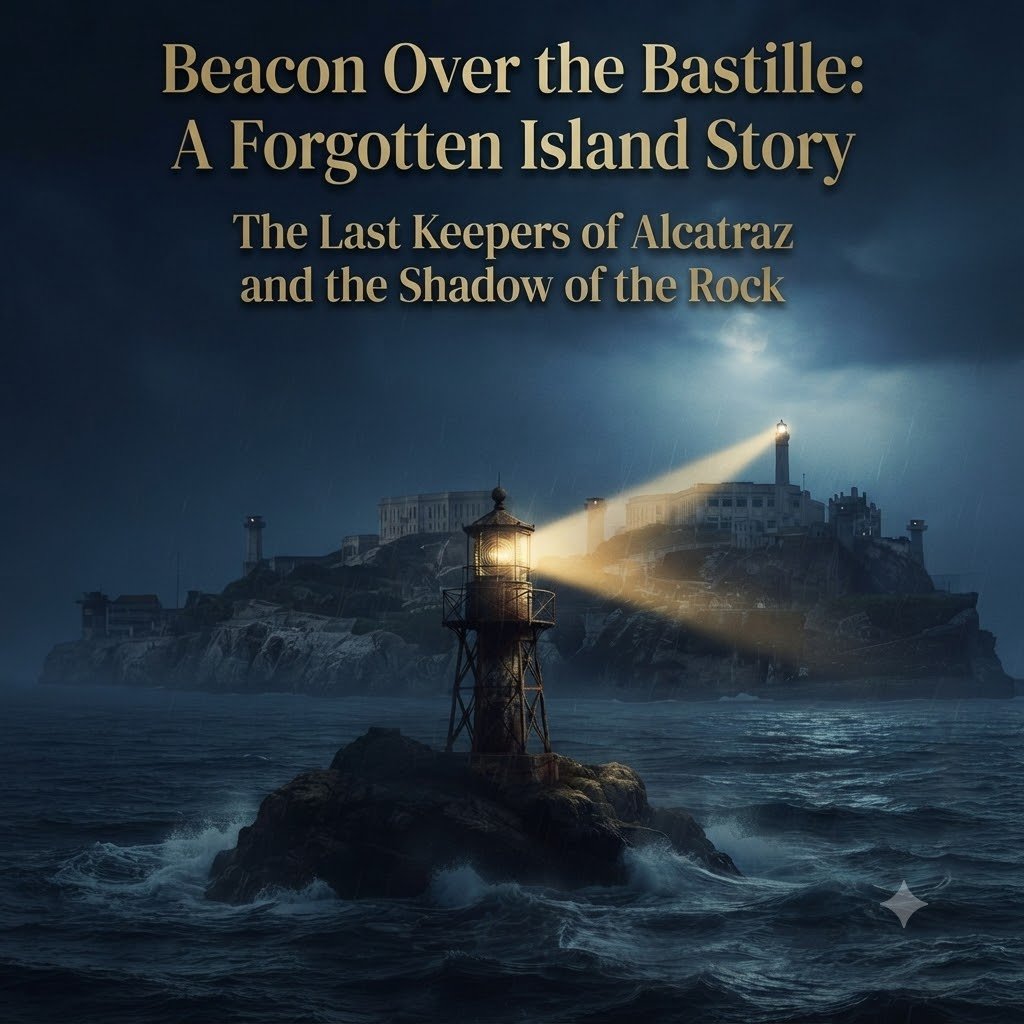
He wiped the condensation from the heavy glass of the lantern room. Inside, the great Fresnel lens—a masterpiece of concentric glass rings—waited for the night. It was a delicate, jewel-like apparatus housed within a cage of iron and brass. To Elias, the lens was more than a machine; it was the island’s heart. It required his touch, his cleaning, and his devotion to ensure that when the sun dipped below the horizon, the beacon would slice through the encroaching gloom, guiding ships safely away from the treacherous shoals of the Devil’s Island.
"Father!"
The voice, light and clear, cut through the muffled silence of the mist. Elias turned to see his twelve-year-old daughter, Clara, climbing the spiral staircase. She carried a steaming mug of coffee, the aroma of roasted beans mingling with the sharp scent of salt spray.
"The light is ready?" she asked, her eyes tracing the intricate brass gears.
"She is, Clara," Elias replied, taking the mug. His hands, calloused and stained with oil, warmed against the ceramic. "The wind is shifting toward the Northwest. We’ll have a heavy soup tonight. Keep the oil lamps in the kitchen trimmed low—we don’t want to waste the reserves."
Clara nodded, her expression turning serious. She understood the weight of their duty. On Alcatraz, life was measured in cycles: the cycle of the tides, the cycle of the light, and the cycle of the supply boat that arrived once a month like a tether to a world that felt increasingly distant. They were the sentinels of the bay, the silent guardians whose lives were defined by the beam they cast into the dark.
For the Miller family—Elias, his wife Martha, and young Clara—Alcatraz was not a place of confinement, but of profound, singular purpose. While the rest of the country was caught in the frantic momentum of the early 20th century, the Millers existed in a pocket of time that moved at the pace of the sea. Their home was a modest, white-washed cottage nestled near the lighthouse, a structure that felt fragile against the looming presence of the cliffs.
Inside the cottage, the air was warm and smelled of dried lavender and sea salt. Martha was at the stove, the cast-iron surface clattering as she prepared a stew. She moved with the fluid grace of someone who had spent years navigating a house that shifted slightly with the gale-force winds.
"The mist is thickening," Martha noted, not looking up from her work. "I can barely see the pier from the window."
"It’ll be a long night," Elias said, joining her at the small wooden table. "The *SS Mariposa* is due to pass the channel around midnight. I want the rotation speed checked twice."
"You worry too much," Martha said, though her smile was soft. "The light has never failed us, Elias. You’ve seen to that."
It was true. The lighthouse was their pride and their burden. Maintaining it was an exacting science. Every brass surface had to be polished to a mirror finish to ensure the light didn't dim; every wick had to be trimmed to a precise length to prevent smoking. It was work that demanded absolute focus, leaving little room for the erratic whims of emotion. Yet, in the quiet moments—when the wind died down and the fog lifted just enough to reveal the distant, twinkling lights of San Francisco—the isolation would press in, heavy and insistent.
Living on Alcatraz meant living on the edge of the world. It was a place where nature reigned supreme. The island was home to a cacophony of life that the mainlanders rarely considered. Cormorants and gulls nested in the crags, their cries echoing through the night like the voices of lost sailors. The seals would haul themselves onto the lower rocks, their guttural barks providing a constant, haunting soundtrack to the family’s existence.
Clara often spent her afternoons in the small garden they had carved out of the rocky soil, where she grew hardy kale and stubborn, bright-orange poppies that seemed to defy the salt spray. It was her sanctuary, a tiny patch of color against the endless grey. She knew the island better than anyone—every hidden crevice where the tide pools shimmered with anemones, every path that led to the sheer drop-offs of the western cliff.
"Do you think the people on the ships ever look up?" Clara asked later that evening, watching as her father meticulously cleaned the lens with a chamois cloth. "Do they look at the light and wonder who is behind it?"
Elias paused, his reflection shimmering in the curved glass. "Most of them are just grateful for the warning, Clara. They don’t think of the person behind the light. And that’s the way it should be. The light is the focus, not the keeper."
"But I like being the keeper," she whispered.
Elias looked at her, seeing the reflection of the lantern in her young, wide eyes. He felt a sudden, sharp pang of protectiveness. He knew that their life here was a privilege, but he also sensed the fragility of it. They were stewards of a government-owned rock, living in a space that served a singular, utilitarian purpose. As long as the lighthouse stood as the primary inhabitant of the island, they were safe. But the world beyond the bay was changing. The newspapers that arrived on the supply boat spoke of new federal policies, of expansion, and of a tightening grip on the nation’s security.
He pushed the thought away. Tonight, there was only the fog and the light.
As the sun sank, the island transformed. The sky bled into a deep, bruised purple, and the mist turned into a cold, clinging vapor. Elias ascended the lighthouse one last time. He lit the mantle, the flame catching with a steady, reassuring hiss. He engaged the clockwork mechanism, and the great lens began its slow, majestic rotation.
*Sweep. Darkness. Sweep. Darkness.*
The light cut a golden path through the swirling fog, a brilliant, rotating finger of safety pointing toward the open sea. From his vantage point, Elias watched as the beam illuminated the churning whitecaps of the bay. He felt a surge of quiet power. For all the vastness of the ocean, for all the mystery of the dark, here was the order he provided.
He stood there for hours, a sentinel in the mist, watching the horizon. Somewhere out there, the *Mariposa* was navigating the treacherous waters, her crew relying entirely on that golden, rhythmic pulse. He was the invisible hand that kept the disaster at bay.
Down in the cottage, Martha and Clara were tucked away, their lives continuing in the small, warm rhythm of the interior. They were safe, and they were together. But as Elias leaned against the cold iron railing, he felt a shiver that had nothing to do with the night air.
The fog seemed to be pressing closer, more insistent than usual. It felt as though the mist was trying to reclaim the island, trying to bury the lighthouse and everything it stood for. He shook his head, blaming the fatigue of the long watch.
The lighthouse was the beacon. It was the constant. And as long as he kept the glass clean and the light burning, the island would remain their home. He turned back to the lens, his hands moving with the practiced efficiency of a man who knew exactly where he belonged.
In the distance, a low, mournful blast of a ship’s horn echoed through the fog—a greeting, or perhaps a salute. Elias acknowledged it with a nod, his eyes fixed on the horizon. He would stay here, watch over the light, and protect this fragile, isolated world until the dawn broke the spell of the mist.
Little did he know, the fog was not the only thing closing in on their sanctuary. The tides of history were shifting, and soon, the light would be the only thing left of the life they had built—a flickering memory against the encroaching shadow of the Rock. ... MORE
For now, however, the beacon held. The night was theirs, and the light continued its steady, defiant rotation, a golden promise in a world of grey.
No reviews found!



No comments found for this product. Be the first to comment!