
A Hidden Tech Story
How a Quiet Bureaucrat Unlocked the Secrets of the Universe and Sparked a New Age
Chapter 1: The Quiet Cog in the Machine
The air in Bern, in the year 1905, was thick with the scent of roasted coffee, damp earth, and the faint, metallic tang of industrial progress. It was a city of ancient cobblestones and precise clockwork, nestled in the embrace of the Aare River, its medieval arcades offering shelter from both sun and snow. But while the world outside the Swiss Federal Institute of Intellectual Property thrummed with the nascent energies of a new century—telephones whispering across wires, automobiles sputtering to life on dusty roads, and electric lights beginning to chase away the tyranny of night—within its quiet walls, a different kind of energy was at play. An unseen, unheard revolution was brewing, not in a bustling laboratory or a grand university lecture hall, but in the meticulous, almost monastic, routine of a single, unassuming civil servant.
His name was Albert Einstein, though in the hallowed, hushed corridors of the Patent Office, he was simply "Herr Einstein," or more formally, "Technical Expert, Third Class." He was twenty-six years old, a young man whose unruly mop of dark hair seemed perpetually at odds with the stiff collar and sober suit he wore. His face, often described as amiable, even boyish, concealed a restless intelligence that rarely found full expression in the bureaucratic world he inhabited. His eyes, however, were a different matter. They were deep, brown pools that held a glint of something far-off, a perpetual curiosity that seemed to peer beyond the immediate, beyond the mundane, into a realm of pure, abstract thought.
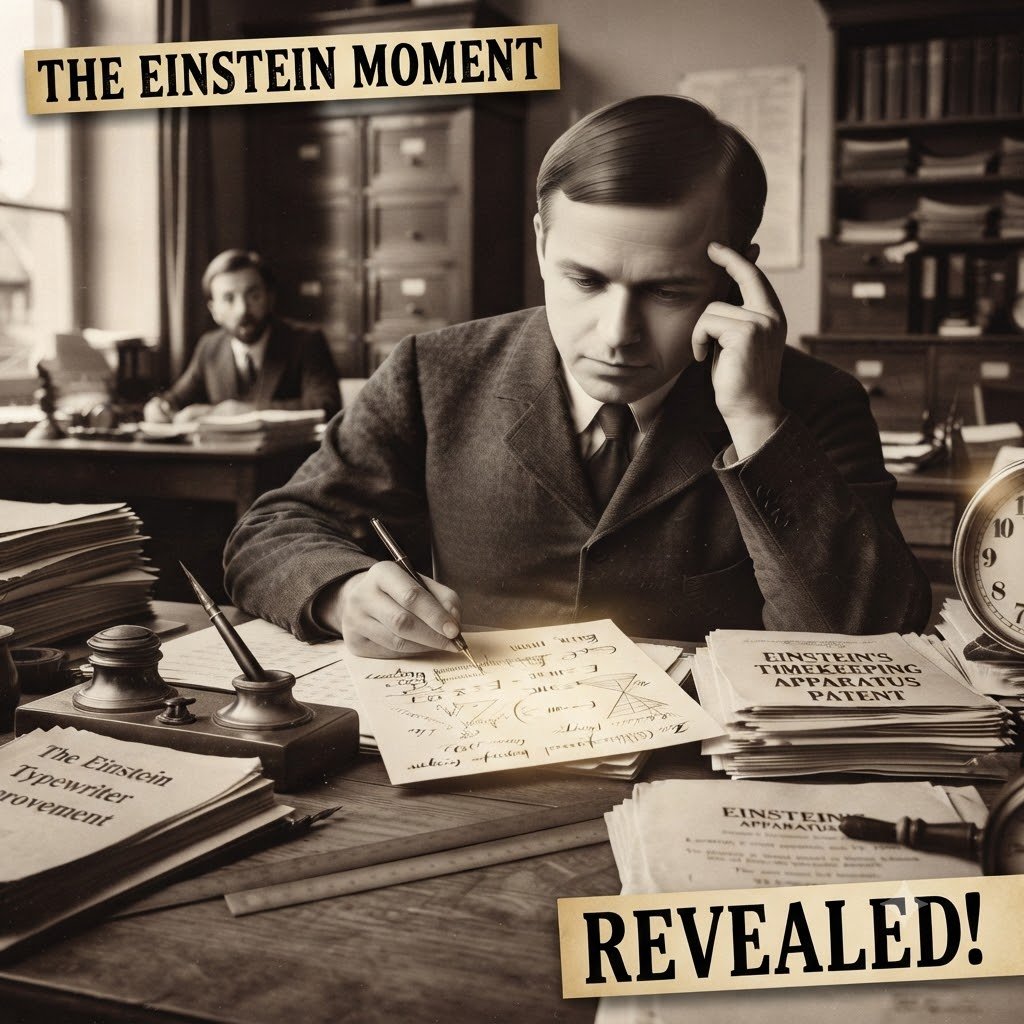
Each morning, with a punctuality that belied his unconventional mind, Einstein would arrive at the imposing sandstone building at Speichergasse 6. He would climb the worn stone steps, the polished banister cool beneath his hand, and settle into his small office. The room itself was unremarkable: a sturdy wooden desk scarred by years of use, a swivel chair that groaned softly with every shift of weight, and shelves stacked high with the technical journals and reference books that were the tools of his trade. Sunlight, when it managed to penetrate the narrow Bernese streets, would filter through the window, illuminating dust motes dancing in the stillness and casting long shadows across the piles of patent applications awaiting his judgment.
His daily routine was a study in methodical diligence. He was tasked with examining the blueprints and specifications of new inventions, sifting through the dreams and ambitions of inventors from across Switzerland and beyond. A steady stream of ingenious, bizarre, and often redundant contraptions flowed across his desk. There were improvements to electric generators, novel designs for clock mechanisms, intricate braking systems for bicycles, and countless variations on telegraphic apparatus. Each application demanded his full attention, a meticulous dissection of its claims, a rigorous assessment of its originality, and a painstaking verification of its feasibility. Was it truly new? Did it work as claimed? Did it infringe upon existing patents? These were the questions that anchored his days, demanding a precision of thought and a clarity of judgment that few possessed.
Einstein was good at his job, exceptionally so. His colleagues, a small fraternity of diligent men, recognized his quick grasp of complex mechanical and electrical principles. He possessed an uncanny ability to cut through the often-convoluted language of patent applications, to grasp the core innovation, or, more often, to expose the fundamental flaws. He was the intellectual equivalent of a master watchmaker, dismantling a mechanism to understand its inner workings, identifying the loose springs or misaligned gears with effortless precision. This work, while seemingly mundane, was sharpening his analytical faculties, honing his ability to spot inconsistencies, to identify assumptions, and to deconstruct complex systems into their fundamental components.
Yet, as his pen glided across the official forms, making neat annotations or scrawling concise objections, his mind was often a thousand miles away, or perhaps, a thousand light-years away. The practical realities of a new spring-driven motor or a refined electrical relay, while important for commerce and industry, were but faint echoes of the deeper questions that truly consumed him. The steady rhythm of the patent office – the rustle of paper, the scratch of pens, the distant clang of the city’s trams – formed a backdrop to an internal symphony of thought experiments, a silent, ceaseless interrogation of the universe itself.
He might be scrutinizing a patent for a new device to synchronize clocks across different railway stations, a common concern in an era of expanding transportation networks. His professional duty would be to ensure the invention's novelty and practicality. But beneath this surface task, his mind would be racing. If two clocks were synchronized and one was then moved, would they remain synchronized? What if the movement was at an enormous speed, approaching that of light? Would the very concept of simultaneity, of "now," hold true for both observers? Such questions, far removed from the practicalities of railway timetables, gnawed at him with an insistent, almost feverish intensity.
The contrast between his external life and his internal world was stark, almost comical. On one hand, he was a dutiful cog in the vast, well-oiled machine of Swiss bureaucracy, ensuring the orderly progress of technological innovation. On the other, he was a lone explorer, charting unknown territories of thought, dismantling the very foundations of reality as understood by the greatest scientific minds before him. The inventions crossing his desk, while often ingenious, were rooted firmly in the classical physics of Isaac Newton and James Clerk Maxwell – a universe of absolute time, fixed space, and light propagating through an invisible, all-pervasive ether. But in Einstein’s mind, that elegant, predictable universe was beginning to fray at the edges.
He was grappling with paradoxes that had stumped the scientific establishment. If light was a wave, what was it waving in? The hypothetical "luminiferous ether," a ubiquitous substance thought to fill all space, had proven stubbornly elusive to detection. Experiments designed to measure Earth’s motion through this ether had yielded baffling null results. And what of motion itself? Was there an absolute state of rest, a cosmic reference frame against which all other movements could be judged? Or was all motion merely relative, dependent on the observer's perspective? .... MORE
No reviews found!





No comments found for this product. Be the first to comment!