
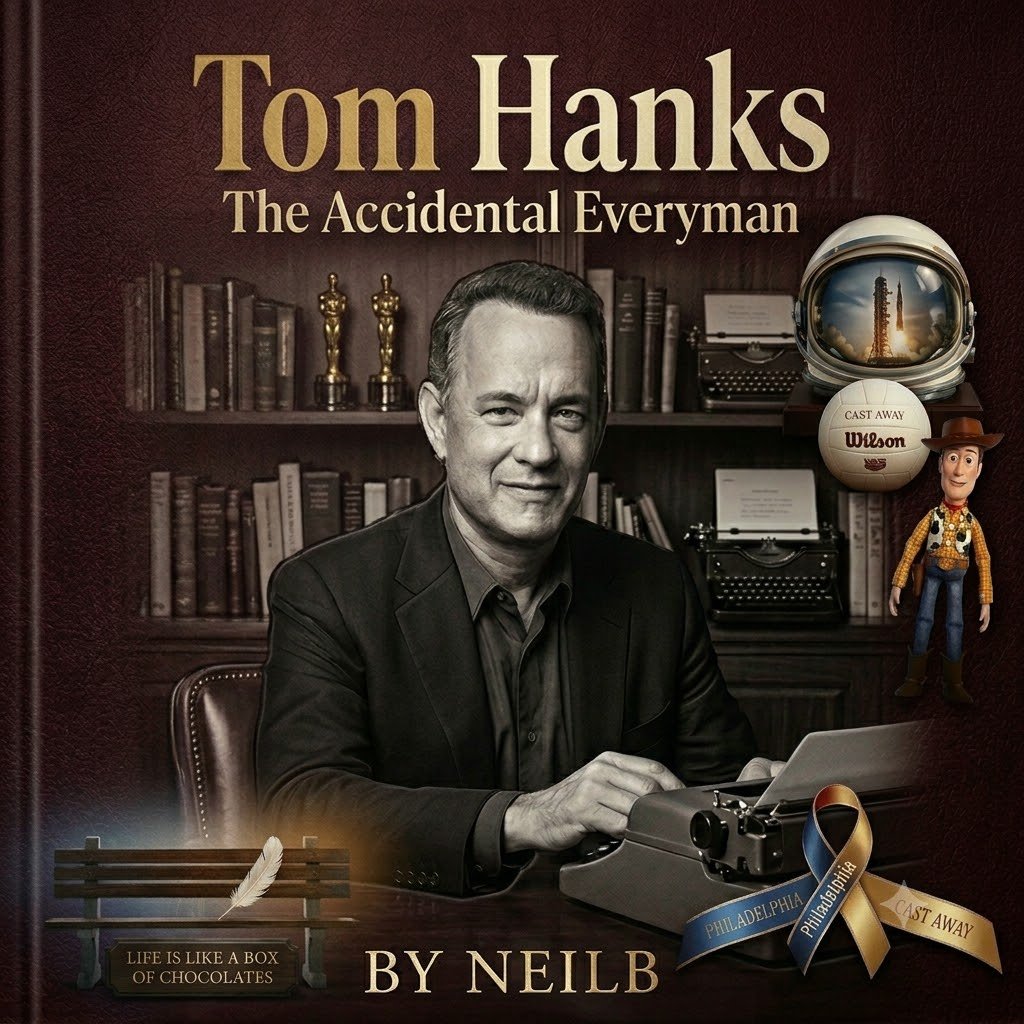
Tom Hanks: The Accidental Everyman
The instability of his early years left a deep imprint on Hanks's personality. He became notably shy and introverted, struggling to form lasting friendships or feel rooted anywhere. In interviews decades later, he would recall feeling like a perpetual outsider, watching the world from a distance rather than actively participating in it. He told Rolling Stone magazine in a candid interview, "I was a geek, a spaz. I was horribly, painfully, terribly shy. At the same time, I was the guy who'd yell out funny captions during filmstrips." This paradox—the painfully shy boy who nevertheless craved attention and sought to make others laugh—would become the foundation of his unique on-screen presence.
Despite his shyness, Hanks discovered an outlet for his creativity and emotions in the world of theater. In high school, he participated in productions such as South Pacific, where he found that acting allowed him to escape his own insecurities and inhabit other personas. The stage became a sanctuary, a place where his awkwardness could be transformed into something purposeful. He later recalled that the first time he performed in front of an audience, he felt an electric jolt of connection—a feeling he would spend the rest of his life chasing.
After graduating from Skyline High School in Oakland, California, in 1974, Hanks enrolled at Chabot College in Hayward, a community college where he initially studied theater. He later transferred to California State University, Sacramento, to continue his education. However, Hanks was never particularly suited to academic life. He found the classroom constraining and yearned for practical experience. In 1977, he dropped out of college to pursue acting full-time, a decision that his family viewed with skepticism but that he felt was essential to his survival.
His big break came when he secured an internship at the Great Lakes Theater Festival in Cleveland, Ohio. This was not a glamorous gig by any measure—it involved long hours, menial tasks, and meager pay—but it proved to be his true education. Over the course of three years, Hanks immersed himself in every aspect of theater production. He learned lighting design, stage management, set construction, and costume maintenance. He studied the mechanics of performance from the ground up, working alongside seasoned actors who taught him the discipline required to sustain a career in the arts. In 1978, his hard work paid off when he won the Cleveland Critics Circle Award for Best Actor for his performance in a production of Shakespeare's The Two Gentlemen of Verona. It was the first major recognition of his talent, and it confirmed that he had made the right choice in abandoning academia.
Chapter 2: From Cleveland to Hollywood
In 1979, with his confidence bolstered by his success in Cleveland, Hanks made the bold decision to move to New York City to pursue a film and television career. The city was intimidating, and Hanks arrived with little money and fewer connections, but he was determined to make his mark. He took on various odd jobs to support himself while attending auditions, often facing rejection after rejection. His first film role was a minor part in the low-budget slasher film He Knows You're Alone (1980), a forgettable horror movie that nevertheless gave him his first taste of working on a professional film set. The experience was humbling—he was on screen for only a few minutes—but it taught him the fundamentals of camera work and the differences between stage and screen acting.
A more significant breakthrough came when he was cast as one of the leads in the ABC sitcom Bosom Buddies (1980-1982). The premise was absurd: Hanks and his co-star Peter Scolari played two young advertising executives who, to afford an apartment in a desirable building, must disguise themselves as women and live in a women-only hotel. The show was silly and often predictable, but it showcased Hanks's natural comedic timing and undeniable charm. Though Bosom Buddies had only modest ratings and was canceled after two seasons, it earned Hanks industry respect and caught the attention of casting directors and producers who recognized his potential.
During this time, Hanks also made guest appearances on popular television shows, including a memorable episode of Happy Days in 1982. His performance as a character who kisses Fonzie's girlfriend caught the attention of director Ron Howard, who was in the early stages of casting a new film. Howard was impressed by Hanks's ease in front of the camera and his ability to blend humor with genuine emotion.
The meeting with Ron Howard proved to be the turning point of Hanks's career. Howard was casting Splash (1984), a romantic comedy about a man who falls in love with a mermaid. Initially, Hanks was considered for a supporting role, but Howard and producer Brian Grazer were so taken with him that they offered him the lead instead. Splash was a gamble—it was a high-concept film with a fantastical premise, and the studio was uncertain about its commercial potential. However, the film was a massive surprise hit, grossing over $69 million at the domestic box office and establishing Hanks as a leading man with broad appeal. Critics praised his performance as charming, relatable, and effortlessly funny, and audiences fell in love with his everyman persona.
Later that same year, Hanks starred in the raucous comedy Bachelor Party, a very different film that traded on his ability to play a likable goofball. The movie was a commercial success, further cementing his reputation as a comedic actor. Over the next few years, Hanks continued to work steadily, starring in films like The Man with One Red Shoe (1985), Volunteers (1985), and The Money Pit (1986). While these films were not critical darlings, they kept him in the public eye and allowed him to refine his craft.
It was the 1988 film Big that truly changed everything. Directed by Penny Marshall, Big told the story of a twelve-year-old boy who makes a wish to be "big" and wakes up the next morning as a thirty-something man. Hanks's performance was nothing short of revelatory—he somehow managed to embody the innocence, curiosity, and exuberance of a child while occupying an adult body. His famous scene at a toy store piano, where he plays "Heart and Soul" and "Chopsticks" with his feet, became one of the most iconic moments in 1980s cinema. For his work in Big, Hanks received his first Academy Award nomination for Best Actor, a recognition that signaled he was more than just a comedic actor.
Chapter 3: The 90s: A Modern Era Begins
The early 1990s were a period of transition for Hanks. He starred in Turner & Hooch (1989), Joe Versus the Volcano (1990), and The Bonfire of the Vanities (1990), a notorious flop that was critically savaged and commercially unsuccessful. The failure of The Bonfire of the Vanities was a humbling moment—it was the first time Hanks had experienced a major setback in his career, and it forced him to reevaluate his choices. He has since admitted that the experience taught him to be more selective about his roles and to trust his instincts rather than simply chasing studio projects.
A major comeback came in 1992 with A League of Their Own, a film about the All-American Girls Professional Baseball League during World War II. Hanks played Jimmy Dugan, a washed-up, alcoholic baseball manager who reluctantly takes charge of a team of women. His performance was a masterclass in balancing comedy and pathos, and his famous line—"There's no crying in baseball!"—became an instant cultural touchstone. The film was a critical and commercial success, and it marked the beginning of what Hanks would later call his "modern era of moviemaking."
This era was defined by two critically acclaimed and beloved films in 1993. The first was Sleepless in Seattle, a romantic comedy directed by Nora Ephron in which Hanks played Sam Baldwin, a widowed father who finds love again through a radio call-in show. The film paired Hanks with Meg Ryan, and their on-screen chemistry was electric. The movie was a massive hit, grossing over $227 million worldwide, and it established Hanks as the premier romantic-comedy star of his generation. His portrayal of a grieving, vulnerable man looking for a second chance at love resonated deeply with audiences, who saw in him an everyman they could root for.
The second film of 1993 was Philadelphia, a groundbreaking drama that took Hanks into much darker territory. He played Andrew Beckett, a gay lawyer who is fired from his prestigious firm after his employers discover he has AIDS. The film was one of the first mainstream Hollywood productions to tackle the AIDS crisis and homophobia head-on, and Hanks undertook the role with immense seriousness and dedication. He lost a significant amount of weight to portray Beckett's physical decline and spent extensive time with AIDS patients and activists to understand their experiences. His performance was devastatingly moving, capturing both Beckett's dignity and his vulnerability. For his work in Philadelphia, Hanks won his first Academy Award for Best Actor. In his acceptance speech, he tearfully acknowledged his high school drama teacher, a moment of genuine emotion that endeared him even further to the public.
He followed this triumph with an even bigger cultural phenomenon: Forrest Gump (1994). Directed by Robert Zemeckis, the film told the story of a man with a low IQ who inadvertently influences major historical events from the 1950s through the 1980s. Playing the title character, Hanks delivered a performance that was both simple and profound, embodying Forrest's innocence, kindness, and unwavering moral compass. The film was a commercial juggernaut, grossing over $678 million worldwide, and it won six Academy Awards, including Best Picture and Best Actor for Hanks. This was his second consecutive Best Actor Oscar, a feat only previously accomplished by Spencer Tracy. Hanks's portrayal of Forrest Gump became so iconic that the character entered the cultural lexicon, representing a particular kind of American optimism and resilience.
This period also saw Hanks successfully branch out into other genres. He played astronaut Jim Lovell in Ron Howard's Apollo 13 (1995), a gripping drama about the aborted moon mission that earned critical praise and multiple Oscar nominations. Hanks's performance as the calm, courageous commander was widely lauded, and the film became a box-office success. In 1995, he also provided the voice for the beloved animated cowboy Woody in Pixar's Toy Story, the first fully computer-animated feature film. Hanks brought warmth and vulnerability to the character, establishing a voice-acting career that would span over two decades and four sequels.
In 1996, Hanks made his directorial debut with the musical comedy That Thing You Do!, a film about a fictional 1960s pop band. Though he also wrote the screenplay and starred in the film, Hanks's primary focus was directing, and he demonstrated a keen eye for period detail and comedic timing. That same year, he founded his production company, Playtone, named after the record label in That Thing You Do!. Playtone would soon become a powerhouse in film and television production, producing acclaimed projects like the Emmy-winning miniseries From the Earth to the Moon (1998).
Chapter 4: A Respectful Icon
As the 1990s drew to a close, Hanks began a fruitful and long-lasting collaboration with director Steven Spielberg. Their first project together was the World War II epic Saving Private Ryan (1998), a visceral and harrowing portrayal of the Normandy invasion and its aftermath. Hanks played Captain John Miller, a weary but principled officer tasked with finding and bringing home a paratrooper whose brothers have been killed in action. The film's opening sequence, depicting the D-Day landing at Omaha Beach, is widely considered one of the most realistic and brutal war scenes ever put on film. Hanks's performance was restrained and powerful, earning him another Academy Award nomination for Best Actor.
Hanks's filmography throughout the late 1990s and 2000s was a remarkable mix of commercial and critical hits. In 1998, he reunited with Meg Ryan for You've Got Mail, a charming romantic comedy about two bookstore owners who fall in love online while being business rivals in real life. The film was a box-office success and solidified Hanks's reputation as a master of the romantic-comedy genre. In 1999, he starred in The Green Mile, a prison drama based on a Stephen King novel, playing a death row guard who witnesses supernatural events. The film was critically acclaimed and earned Hanks still more praise for his ability to convey deep empathy and moral complexity.
Perhaps one of his most physically demanding roles came in 2000 with Cast Away, directed by Robert Zemeckis. Hanks played Chuck Noland, a FedEx executive who becomes stranded on a remote desert island after a plane crash. The film required Hanks to lose a dramatic amount of weight—more than 50 pounds—during the production to depict his character's physical deterioration over four years. He also spent months preparing for the role, learning survival skills and working with a trainer. His performance, which relied heavily on physical expression and minimal dialogue, was nothing short of extraordinary. He was nominated for an Academy Award for Best Actor, and the film was both a critical and commercial success, grossing over $429 million worldwide.
In 2002, Hanks achieved another milestone when he became the youngest person ever to receive the American Film Institute's Life Achievement Award. The honor recognized his immense contributions to cinema and his status as one of the most respected actors of his generation. That same year, he starred in two major films: Catch Me If You Can, directed by Steven Spielberg, in which he played an FBI agent hunting a young con artist; and Road to Perdition, a crime drama directed by Sam Mendes in which he played a mob hitman seeking redemption. Both films showcased Hanks's versatility and his ability to play morally complex characters.
In 2006, Hanks took on a different kind of challenge when he portrayed symbologist Robert Langdon in The Da Vinci Code, an adaptation of Dan Brown's blockbuster novel. The film was a massive commercial success, despite receiving mixed reviews, and it spawned two sequels: Angels & Demons (2009) and Inferno (2016). Hanks brought intellectual gravitas to the role, anchoring the franchise with his dependable presence.
Behind the camera, Hanks continued to build his reputation as a producer. Playtone produced the critically acclaimed HBO miniseries Band of Brothers (2001), which Hanks co-executive-produced with Steven Spielberg. The series, which followed the experiences of Easy Company from training through the end of World War II, was a monumental achievement in television, winning numerous Emmy and Golden Globe awards. Hanks and Spielberg collaborated again on The Pacific (2010), another HBO miniseries that explored the Pacific theater of the war. Playtone also produced John Adams (2008), an Emmy-winning miniseries about the Founding Father, and Big Love (2006-2011), a critically acclaimed drama series about a polygamous family.
Chapter 5: The National Treasure
By the 2010s, Tom Hanks had cemented his status as an American cultural icon—a figure who was not just beloved but also trusted. He had become synonymous with a certain kind of decency, integrity, and everyman appeal that made audiences feel as though they knew him personally. This reputation was reinforced by his choice of roles, many of which portrayed real-life heroes and historical figures.
In 2007, he played Congressman Charlie Wilson in Charlie Wilson's War, a political drama about a Texas congressman who helped fund the Afghan resistance against the Soviet Union. His performance was witty and charismatic, earning him critical praise. In 2013, he portrayed Captain Richard Phillips in Captain Phillips, a thriller based on the true story of a merchant mariner who was taken hostage by Somali pirates. Hanks's performance was intense and gripping, particularly in the film's final moments, where his character experiences a delayed emotional breakdown—a scene widely considered one of the finest moments of his career. Later that same year, he played Walt Disney in Saving Mr. Banks, a behind-the-scenes drama about the making of Mary Poppins. Hanks captured Disney's charm and business acumen, bringing warmth to a complex figure.
In 2016, Hanks took on the role of Captain Chesley "Sully" Sullenberger in Sully, directed by Clint Eastwood. The film told the story of the "Miracle on the Hudson," in which Sully successfully landed a disabled plane on the Hudson River, saving all 155 people on board. Hanks's portrayal was understated and deeply empathetic, capturing the quiet heroism of a man who performed an extraordinary feat under immense pressure. The film was a commercial success and reinforced Hanks's image as a modern-day hero.
He continued his collaboration with Steven Spielberg in the Cold War thriller Bridge of Spies (2015), in which he played James B. Donovan, a lawyer who negotiates a prisoner exchange with the Soviet Union. His performance earned him an Academy Award nomination for Best Supporting Actor. In 2017, he reunited with Spielberg for The Post, a drama about the Washington Post's decision to publish the Pentagon Papers. Hanks played editor Ben Bradlee opposite Meryl Streep's Katharine Graham, and the film was praised for its timely exploration of press freedom.
In 2013, Hanks made his Broadway debut in Nora Ephron's Lucky Guy, a play about the life of journalist Mike McAlary. His performance earned him a Tony Award nomination, demonstrating that even after decades in front of cameras, he could still command a live stage. His portrayal of beloved television personality Fred Rogers in A Beautiful Day in the Neighborhood (2019) earned him his sixth Oscar nomination. Hanks brought a quiet, contemplative quality to the role, capturing Rogers's gentle wisdom and empathy. The same year, he reprised his role as Woody for the fourth and final Toy Story film, bringing a poignant conclusion to the character's journey.
In recognition of his immense contributions to American culture, Hanks received the Kennedy Center Honor in 2014 and the Presidential Medal of Freedom in 2016, the highest civilian honor in the United States. These awards affirmed his status as a national treasure, a figure whose work had not only entertained millions but also reflected the best of American values.
Chapter 6: The Story Continues
Entering his 60s, Hanks showed no signs of slowing down. In March 2020, during the early days of the COVID-19 pandemic, Hanks and his wife, Rita Wilson, became one of the first celebrity couples to test positive for the virus while in Australia. Their diagnosis made global headlines, and the couple documented their symptoms and recovery on social media, helping to demystify the illness and encourage mask-wearing and vaccination. Hanks's willingness to share his experience publicly was characteristic of his openness and his sense of social responsibility.
Despite the challenges of the pandemic, Hanks continued to work prolifically. He wrote and starred in Greyhound (2020), a naval war film about a U.S. Navy commander during the Battle of the Atlantic. The film was released on Apple TV+ to positive reviews, with Hanks's performance praised for its intensity and authenticity. In 2021, he starred in Finch, a post-apocalyptic drama about a robotics engineer who builds an android to care for his dog after he dies. The film was a quiet, reflective piece that showcased Hanks's ability to carry a film with minimal supporting cast.
In 2022, Hanks took on one of his most transformative roles yet, portraying Colonel Tom Parker, the controversial manager of Elvis Presley, in Baz Luhrmann's biopic Elvis. Hanks disappeared behind heavy prosthetics and an accent to play the manipulative, enigmatic Parker, earning critical praise for his willingness to play such an unlikable character. The same year, he starred in A Man Called Otto, an adaptation of the Swedish novel A Man Called Ove, playing a grumpy widower who finds redemption through his neighbors. The film was a heartfelt dramedy that demonstrated Hanks's continued ability to connect with audiences on an emotional level.
In 2023, Hanks released his second novel, The Making of Another Major Motion Picture Masterpiece, a sprawling work about the making of a superhero film. The book was a blend of fiction and insider knowledge, drawing on Hanks's decades of experience in the industry. His first novel, Uncommon Type, a collection of short stories published in 2017, had been a modest success, and his second novel showed his growth as a writer.
Today, Tom Hanks remains one of the most beloved and respected figures in the world. His career is a testament to the power of perseverance, hard work, and genuine talent. From a shy, nomadic childhood to becoming a two-time Oscar winner, a producer, a director, a writer, and a cultural icon, Hanks's journey has been nothing short of extraordinary. He has entertained audiences for more than four decades, bringing warmth, humor, and humanity to every role he plays. Yet perhaps his greatest achievement is the way he has conducted himself off-screen—as a devoted husband to Rita Wilson, whom he married in 1988; as a father to four children; as a collector of vintage typewriters; and as a man who has never lost his sense of humility or his gratitude for the life he has been given. Tom Hanks is more than a movie star; he is a symbol of a certain kind of American decency, a "nice guy" who earned his success through talent, integrity, and an unwavering commitment to his craft.
No reviews found!


No comments found for this product. Be the first to comment!